12 months
Enhance and refine existing research with academic supervision toward completion, defence, and the award of a doctoral degree/qualification upon successful completion.
12 months
Enhance and refine existing research with academic supervision toward completion, defence, and the award of a doctoral degree/qualification upon successful completion.
EU-Recognised Framework
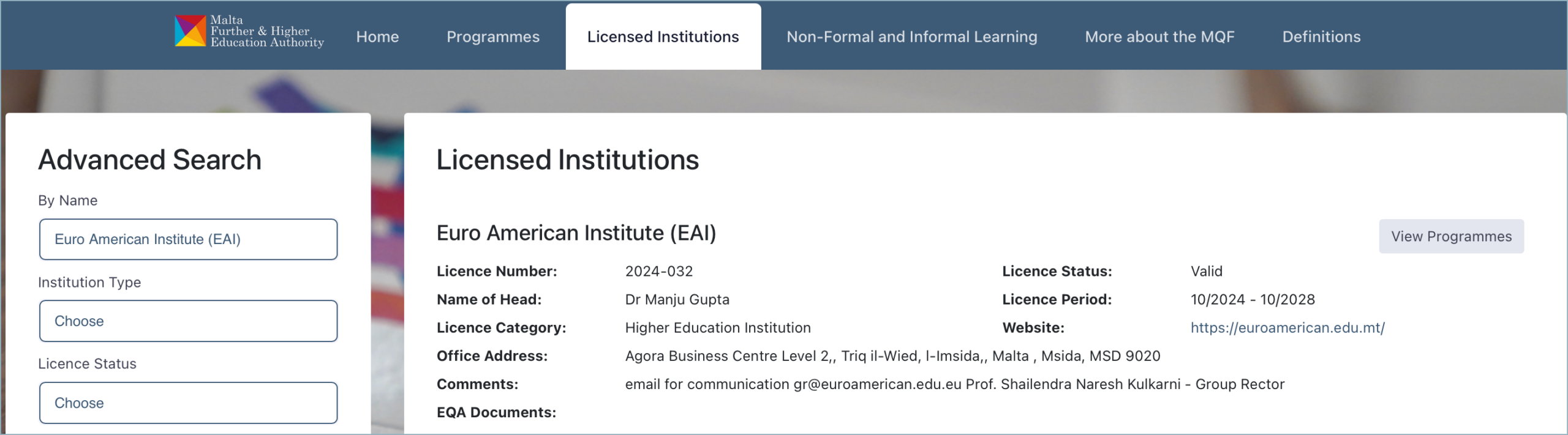
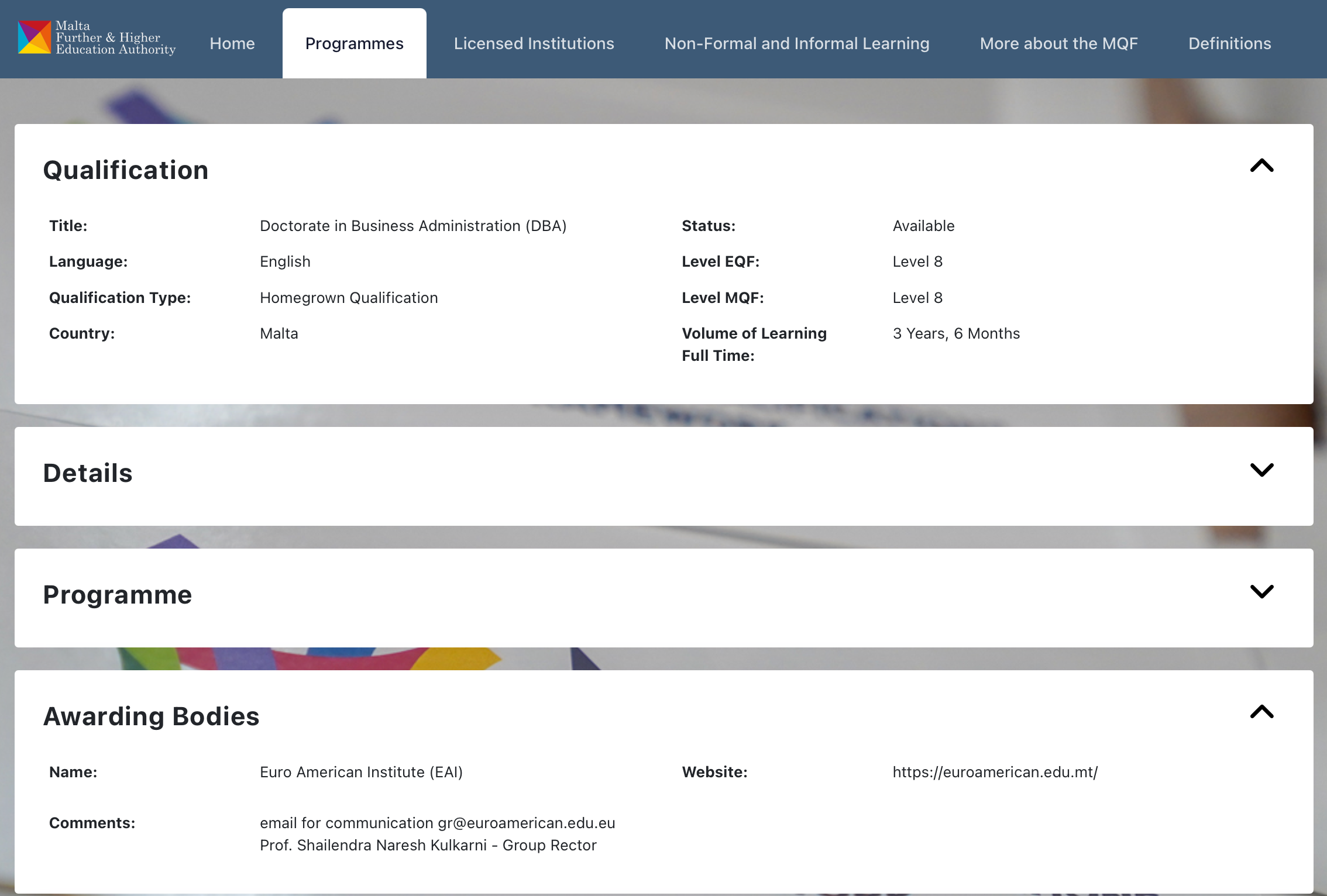
Delivered by a licensed institution in Malta and aligned with the Malta Qualifications Framework and European Qualifications Framework.
EU-Recognised Framework
Delivered by a licensed institution in Malta and aligned with the Malta Qualifications Framework and European Qualifications Framework.
80% Refund
An 80% refund may apply if the expected outcome is not achieved, with an initial detailed consultation provided before proceeding.
80% Refund
An 80% refund may apply if the expected outcome is not achieved, with an initial detailed consultation provided before proceeding.
Save 80%
Tuition costs may be reduced by up to 80% compared to selected study pathways in Europe, and potentially more when accommodation and relocation costs are considered.
Save 80%
Tuition costs may be reduced by up to 80% compared to selected study pathways in Europe, and potentially more when accommodation and relocation costs are considered.
Recognised within the Malta/EU Framework and Referenced through ENIC-NARIC
Malta is an EU, Schengen, Commonwealth, and Bologna Process member state. Its higher education system is regulated by MFHEA, with qualifications positioned under the Malta Qualifications Framework and referenced to European frameworks.
Program Accreditation under MFHEA
Program AccreditationRecognition/Comparability Assessment through MQRIC – ENIC-NARIC Malta
Recognition Assessment GuideAPEL.Q Process in Detail
We support applicants from application submission through competency assessment and, where successful, the award of the DBA qualification.
DBA Qualification Awarded upon Completion of the APEL.Q Process
Upon successful completion of the APEL.Q process for the Doctorate in Business Administration program, applicants may be awarded the Doctorate in Business Administration qualification by EAI Malta, together with an academic transcript indicating MQF/EQF Level 8 where applicable, in accordance with EAI’s academic regulations and approval decisions.
Information about the institution and program may be verified through the public register of the Malta Further and Higher Education Authority (MFHEA).
Admission Requirements
Applicants are normally expected to hold a Master’s degree and have a minimum of 10 years of professional experience.
Applicants should provide at least one of the following:
- A research proposal
- A draft or completed thesis/dissertation
- Published academic articles or research papers
- Documents, prototypes, products, or other evidence demonstrating innovation, improvement, or outcomes from previous research or professional practice
Applicants will receive guidance throughout the APEL.Q application process, including support with procedures, documentation, and submission requirements.
APEL.Q Implementation Process for the Doctorate in Business Administration
1. Consultation and Initial File Assessment before Enrolment
Applicants are consulted to determine whether their existing documents and profile are suitable for the requirements and standards of the APEL.Q pathway for the Doctorate in Business Administration.
This step helps both the applicant and the receiving institution assess the likelihood of success and avoid unnecessary time and cost.
2. Submission of APEL.Q Application File
After the preliminary assessment indicates a strong likelihood of success, the applicant submits the file for review under the APEL.Q process, including:
- Personal and academic records
- Highest qualification
- CV describing managerial experience and professional field
- Research proposals, ongoing or completed research, academic papers, or completed research works
At this stage, applicants are supported in completing the initial application file in accordance with the APEL.Q standards for the Doctorate in Business Administration.
3. Assessment of the Suitability of Prior Research
The authorised academic panel or academic department reviews the file submitted in Step 2 to assess the applicant’s completed or ongoing research against the expected outcomes of a completed doctoral thesis.
The outcome is an APEL.Q assessment report recommending how the applicant’s existing research may be upgraded to meet the required output standards.
4. Delivery of the APEL.Q Assessment Report to the Applicant
After the assessment, the applicant receives an APEL.Q assessment report. The report may include:
- Comments on the strengths of the file
- Research components that may be carried forward
- Areas requiring supplementation or improvement
- Proposed development direction for the DBA thesis
- Recommendations on timeline, structure, and academic requirements
The APEL.Q report does not replace the DBA thesis. It serves as a basis for determining how the applicant may use prior research within the DBA pathway.
5. Approval of the DBA Pathway under APEL.Q
The applicant’s DBA research or research improvement pathway is developed based on the research assessment report in Step 4.
The applicant confirms their commitment to following the approved pathway before a supervisor is assigned.
6. Supervisor Assignment
A suitable supervisor is assigned according to the applicant’s research field, professional experience, and intended thesis direction. The supervisor’s role is to support the applicant in:
- Refining the research question
- Strengthening the theoretical foundation
- Improving the research methodology
- Adding data or analysis where necessary
- Upgrading existing research into a DBA thesis
- Preparing the thesis for defence
The supervisor does not write the thesis on behalf of the applicant, but accompanies and guides the applicant to help ensure the research meets the standards of the Doctorate in Business Administration.
7. Completion of the DBA Research
The applicant develops and upgrades the existing research into a complete DBA thesis.
At this stage, the applicant may receive support in:
- Supervision and academic guidance
- English language and formatting
- Similarity and academic integrity checks to reduce unintentional plagiarism risks
8. Academic Review and Quality Assurance
Before official submission, the thesis is reviewed for academic quality, structure, citations, consistency, academic integrity, and compliance with programme requirements.
At this stage, the applicant may receive support tools to reduce issues related to formatting and unintentional similarity.
9. Independent Assessment and Review
The thesis is submitted to the academic board or independent reviewers in accordance with programme regulations.
This stage determines whether the thesis meets the requirements of a Doctorate in Business Administration.
Possible outcomes may include:
- Approved for defence
- Minor revisions required
- Major revisions required
- Not yet approved and further development required
The applicant must respond to academic feedback and revise the thesis before defence, where required.
At this stage, the supervisor may support the applicant in revising the thesis.
10. DBA Thesis Defence
After the thesis is approved for defence, the applicant attends an oral defence before the panel. During the defence, the applicant presents:
- Rationale for the topic
- Research problem
- Research methodology
- Key findings
- Contribution to business management
- Practical application value
- Future research or development directions
The panel evaluates the applicant’s research capacity, ability to respond to questions, mastery of the topic, and contribution of the thesis.
At this stage, the applicant may receive preparation support before the defence, including guidance on requirements, procedures, thesis presentation format, and practice sessions with the supervisor to ensure appropriate preparation.
11. Post-Defence Completion and Graduation Review
After the defence, the applicant completes final revisions if required by the panel. Once the thesis is finalised, the file is submitted for graduation review.
Graduation conditions may include:
- Completion of the thesis to the required standard
- Successful thesis defence
- Completion of post-defence revisions, if any
- Fulfilment of academic and administrative requirements
- Approval by the academic board or authorised graduation committee
Once confirmed, the applicant proceeds to the degree award process in accordance with the awarding institution’s regulations.
What Support Do You Receive When Joining the APEL.Q Pathway for the Doctorate in Business Administration?
APEL.Q applicants for the Doctorate in Business Administration may receive structured support from profile consultation and prior research assessment to supervisor assignment, upgrading existing research into a DBA thesis, academic review, defence preparation, thesis defence, and graduation review, subject to institutional regulations and academic requirements.
1. Initial Consultation Support
Applicants are consulted to determine the suitability of their profile, managerial experience, and existing research against the standards of the APEL.Q pathway for the Doctorate in Business Administration.
This step helps applicants understand whether they are suitable for the APEL.Q pathway, thereby avoiding unnecessary time, cost, and effort if the profile does not yet provide a sufficient foundation for developing a DBA thesis.
2. Support in Reviewing the Entry File
Applicants are guided in preparing and completing the entry file, including personal records, qualifications, professional CV, managerial experience, research proposals, ongoing research, articles, or completed works.
The file review helps identify which documents may be used, which areas need supplementation, and how the file should be presented to meet APEL.Q requirements.
3. Support in Assessing Prior Research
The applicant’s completed or ongoing research may be reviewed against the expected outcomes of a completed doctoral thesis.
Through this assessment, applicants can understand the strengths, gaps, and development potential of their existing research. This is an important step in determining how prior research should be upgraded, which parts should be supplemented, and what direction should be followed.
4. Support through the APEL.Q Evaluation Report
After the review, applicants may receive an APEL.Q evaluation report, which provides a clearer view of the research pathway, including transferable components, areas for improvement, the proposed direction for developing the DBA thesis, and recommendations on timeline, structure, and academic requirements.
The APEL.Q report serves as an important basis for applicants to build a realistic research plan that matches their capacity, profile, and academic objectives. The report does not replace the DBA thesis or guarantee the final academic outcome.
5. Support in Developing the Research Pathway
Based on the APEL.Q evaluation report, applicants are supported in developing a research pathway or research improvement plan. This pathway helps applicants understand each stage to be completed, the parts that need improvement, and the requirements to be met before moving to the next stage.
A clear pathway helps applicants avoid fragmented, unfocused, or misaligned research development.
6. Support in Supervisor Assignment
Applicants may be assigned a supervisor appropriate to their research field, professional experience, and thesis direction. The supervisor supports the applicant in developing and upgrading prior research into a complete DBA thesis.
This support may include refining the research question, adjusting the theoretical framework, improving the research methodology, adding data or analysis, preparing for review, and guiding the applicant to complete the thesis according to DBA standards.
The supervisor provides academic guidance but does not write the thesis on behalf of the applicant or guarantee the final academic outcome.
7. Support in Completing the Research into a DBA Thesis
Applicants are supported in developing, improving, and upgrading their existing research into a complete DBA thesis. Supervisors may focus on clarifying the research problem, strengthening the academic foundation, refining the thesis structure, improving the quality of analysis, and demonstrating the contribution of the research to business management.
The aim is not merely to edit existing research, but to help applicants develop it into a thesis with academic value, practical application value, and readiness for defence, subject to academic review.
8. English Language and Academic Formatting Support
During thesis completion, applicants may receive support with academic English and presentation formatting. This support helps the thesis become clearer, more professional, and more aligned with the programme’s submission requirements.
Support may include reviewing presentation style, chapter structure, citations, references, tables, appendices, and other formatting requirements.
9. Support in Checking Unintentional Plagiarism
Applicants may be supported in using tools and review processes to reduce unintentional plagiarism risks. This helps applicants review citation practices, wording, use of sources, and originality requirements.
This is an important step in supporting academic integrity and reducing risks during independent assessment. It does not replace the applicant’s responsibility to ensure the originality and integrity of their submitted work.
10. Support in Quality Review before Submission
Before official submission, applicants may receive support in reviewing academic quality, structure, citations, consistency, and compliance with programme requirements.
This review helps identify issues early, avoiding cases where the thesis may be returned due to presentation issues, academic errors, lack of logical flow, or failure to meet expected outcomes.
11. Support in Responding to Feedback after Independent Assessment
When the thesis is independently assessed or reviewed, applicants may receive supervisory guidance to understand and respond to academic feedback. If minor or major revisions are required, applicants are guided on how to make appropriate revisions.
This support helps applicants address feedback systematically and avoid irrelevant revisions or missed requirements from the review panel.
12. Support in Preparing for Thesis Defence
Before the defence, applicants may receive support in preparing the necessary components, including defence requirements, procedures, assessment model, presentation structure, common questions, and response strategies before the panel.
The aim is to help applicants enter the defence with strong preparation, clear understanding of their research contribution, and confidence in presenting before the panel.
13. Post-Defence Completion Support
After the defence, if the panel requires revisions, applicants may continue to receive support in completing the final amendments. This helps ensure the thesis is finalised according to the required standards before moving to graduation review.
14. Support during Graduation Review
Once the thesis has been approved, where applicable, applicants are guided in completing the required academic and administrative obligations for graduation review.
After all academic and administrative requirements are fulfilled, the applicant may proceed to the degree award process in accordance with the regulations of the awarding institution.
Graduation Requirements
Completion of the Initial APEL.Q Process
Applicants must complete the initial application requirements, including prior research, professional experience, and existing qualifications.
Approval of Research Direction
Applicants must have an approved research proposal or research direction that clearly identifies the research problem, objectives, methodology, and expected contribution.
Completion of the DBA Thesis
Applicants must complete a DBA thesis that meets the academic standards of the programme and demonstrates independent research capability, academic value, and practical contribution to business management.
Successful Thesis Defence
Applicants must successfully defend the DBA thesis before the authorised viva or doctoral examination panel in accordance with programme regulations.
Completion of Administrative Procedures and Records
Applicants must complete all required academic, administrative, and financial obligations and submit the necessary personal records, qualifications, transcripts, academic evidence, and related documents.
Compliance with Academic Regulations and Research Ethics
Applicants must comply with academic integrity, originality, data protection, and research ethics requirements.
Approval by the Awarding Institution
Graduation becomes effective only after all academic results, thesis examination outcomes, records, and related obligations have been reviewed, confirmed, and approved by the authorised awarding institution.
The APEL.Q application file and final thesis are treated as confidential academic records and may only be accessed by authorised parties in accordance with GDPR and applicable data protection regulations.
Refund policy of up to 80%
Submission
100% Refund
Candidates receive detailed consultation before submitting their portfolio application and are eligible for a 100% refund if the application is rejected.
Contact Us
Internal Assessment
50% Refund
Candidates will receive a 50% refund of this payment installment if the first three competency assessments are not passed. No refund will be given if the candidate does not proceed according to the required timeline.
Contact Us
External Assessment
80% Refund
Candidates will receive up to 80% refund of this payment installment if the second portfolio submission is still unsuccessful. No refund will be given if the candidate does not proceed according to the required timeline.
Contact Us
Submission
100% Refund
Candidates receive detailed consultation before submitting their portfolio application and are eligible for a 100% refund if the application is rejected.
Contact Us Internal Assessment
50% Refund
Candidates will receive a 50% refund of this payment installment if the first three competency assessments are not passed. No refund will be given if the candidate does not proceed according to the required timeline.
Contact Us External Assessment
80% Refund
Candidates will receive up to 80% refund of this payment installment if the second portfolio submission is still unsuccessful. No refund will be given if the candidate does not proceed according to the required timeline.
Contact Us